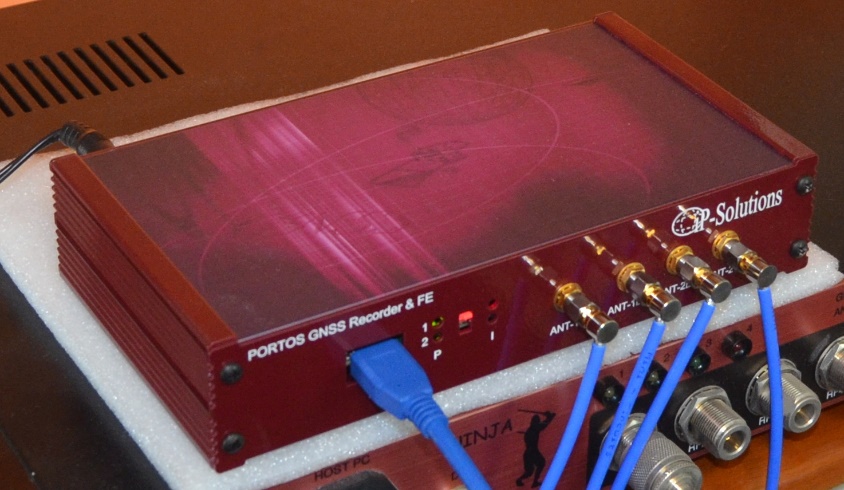
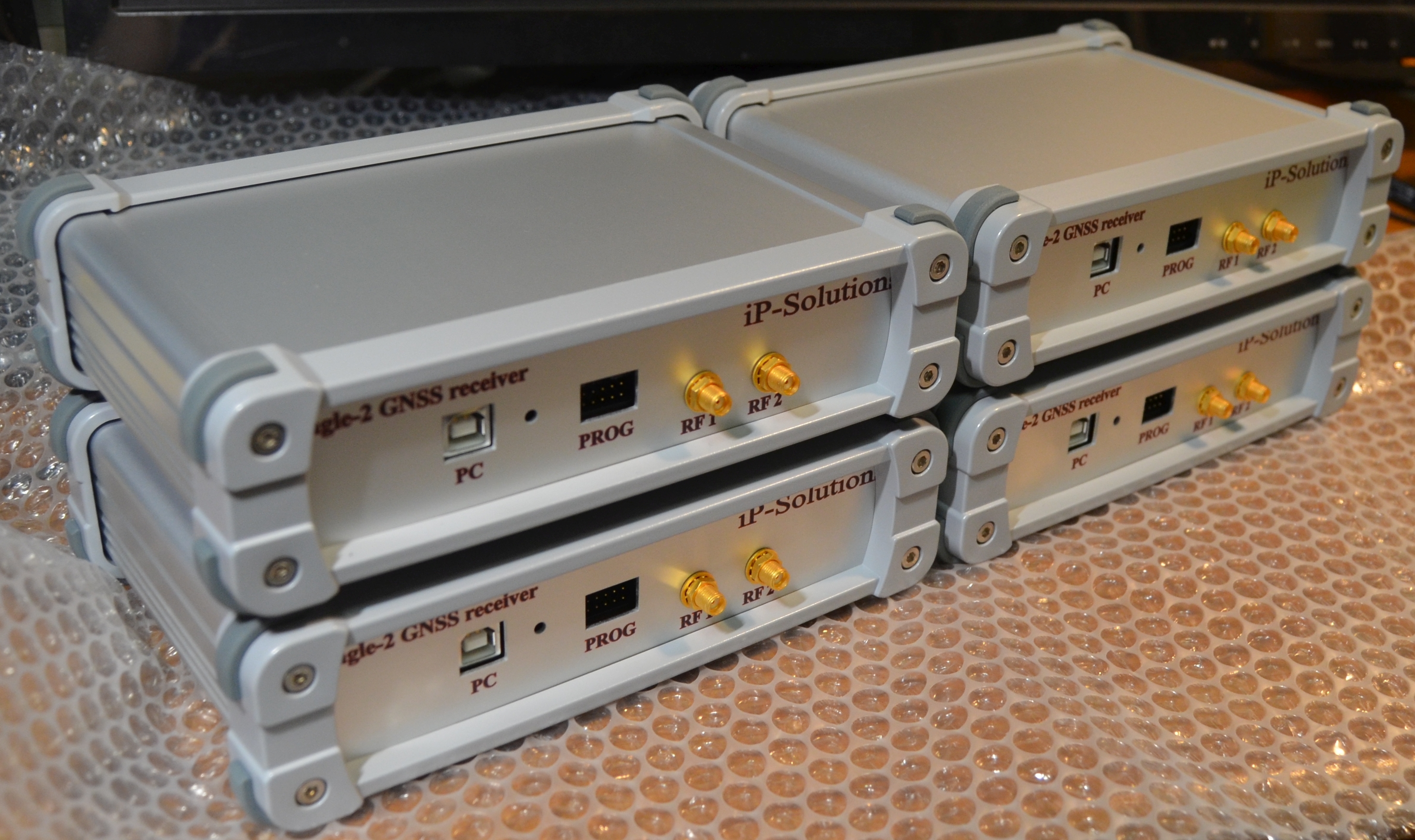
Choose the enclosure and antenna count around the experiment.
RF channels, center frequencies, bandwidths, sampling rates, clocking and interfaces are specified with the order. The A-number identifies the principal antenna-input configuration; it does not limit a unit to one RF frequency per antenna.
01
PORTOS A1
Compact · single antenna input
The smallest and least expensive PORTOS option for conventional multi-frequency SDR reception, RF recording, algorithm development and field measurements.
Real-time operation with ARAMIS
Recorded DIF for post-processing
Order-specific multi-frequency RF configuration
02
PORTOS A2
Compact · dual antenna input
A compact platform for two-antenna measurements, differential reception, reflectometry, orientation experiments and comparative signal studies.
Common timing for two antenna paths
Live ARAMIS or recorded-data operation
Smaller and lower-cost than the A8
03
PORTOS A4
Compact · up to four antenna inputs
A compact multi-channel front end for antenna-array, CRPA and coordinated signal-acquisition work.
Up to four configurable input paths
Common timing across channels
Live processing or DIF recording
04
PORTOS A8
Rackmount · up to eight antenna inputs
The high-channel-count platform for multi-antenna research, CRPA, coherent acquisition, ionosphere monitoring and GNSS-INS development. Combined with the ARAMIS SDR engine, it forms the RAD GNSS SDR receiver.
Compact PORTOS-class hardware configurations. Final connectors, RF cards and interfaces depend on the ordered configuration.
Receiver and laboratory workflow
PORTOS supplies the RF hardware. ARAMIS supplies the GNSS SDR processing.
PORTOS down-converts and digitizes antenna signals, supplies the receiver-side RF/DIF streams, and can record them for later processing.
Live receptionAntenna → PORTOS → ARAMIS ISM, RAD or Academic receiver
Post-processingPORTOS recording → DIF files → ARAMIS or customer software
RF playbackRecorded or simulated file → ReGen / Replicator playback hardware → receiver under test
Recording and RF playback are separate functions. PORTOS is not presented as a real-time retransmitter; ReGen with Replicator hardware provides the controlled RF playback or simulation path.
PORTOS RF channels are specified for the required GNSS bands, sampling and bandwidth, then mapped to the appropriate antenna inputs.
One antenna may feed several RF paths through a splitter. A2, A4 and A8 configurations preserve separate antenna paths under a common clock. A8 provides up to eight configurable channels.
Acquire several antenna inputs under a common timing architecture for CRPA, direction finding, adaptive processing and antenna-array experiments.
02
Receiver algorithms
Work with samples, baseband data, correlators and observables rather than being limited to a closed position output.
03
Ionosphere & scintillation
Configure the signal path and processing for propagation monitoring, amplitude and phase analysis, and multi-frequency studies.
04
Recording & analysis
Record RF environments for subsequent analysis and controlled RF reproduction using a separate ReGen / Replicator system.
Data & software access
Work below the final position solution.
PORTOS supplies RF acquisition, digitized-IF streaming and recording. Its C++ acquisition interface connects customer software. ARAMIS adds GNSS receiver processing through the separate NAV API and BASE API.
Raw multi-channel signal samples
Live PORTOS-to-ARAMIS real-time operation
Baseband I/Q and correlator visualization
PORTOS C++ acquisition interface
ARAMIS NAV API and BASE API for receiver processing
Customer algorithms for acquisition, tracking and positioning
RTKLIB integration and research positioning workflows
Real-time operation and repeatable post-processing
RAD brings RF, timing and inertial data into the same experiment.
RAD combines ARAMIS SDR processing and PORTOS A8 hardware with external timing and synchronized IMU data collection for GNSS–INS development.
An optional IMU/INS integration project can support loose, tight or ultra-tight coupling and BGPS™ instant-positioning know-how. PORTOS A8 is currently supported. Other PORTOS configurations depend on the selected front end.
External frequency reference, 1PPS and trigger interfaces
RS-422 IMU adapter and packet decoding
Receiver and inertial data in a common processing workflow
Real-time experiments and recorded-data analysis
Controlled record & playback
Recording and playback remain separate.
PORTOS records GNSS/RF signal environments for later analysis. Laboratory playback is performed independently by ReGen. The two units are intentionally unsynchronized and provide no real-time recording-to-transmission path.
PORTOS and ARAMIS evaluated for NavIC + GPS research.
Dr. Mehul V. Desai, Dr. Darshna D. Jagiwala and Dr. Shweta N. Shah evaluated a customized integrated PORTOS RF front end and ARAMIS SDR receiver for NavIC L5 + GPS L1 ionospheric-correction and positioning research published in IETE Technical Review. The SAC/ISRO-funded work used raw signal data and the ARAMIS Navigation API.
Define the antennas, signals and data access first.
Tell us the frequencies, antenna count, bandwidth, sampling, timing, recording, software and IMU requirements. We will select PORTOS A1, A2, A4 or A8 and the required ARAMIS configuration.