Ionosphere & scintillation
Use specialized observables, monitoring displays and configurable processing for amplitude, phase and propagation studies.

GNSS SDR receivers for monitoring, R&D and teaching
ISM is the ionospheric scintillation monitor. RAD is the rapid application development receiver built with PORTOS A8. Academic editions support research and teaching.

ARAMIS ISM GNSS SDR ionospheric scintillation monitor
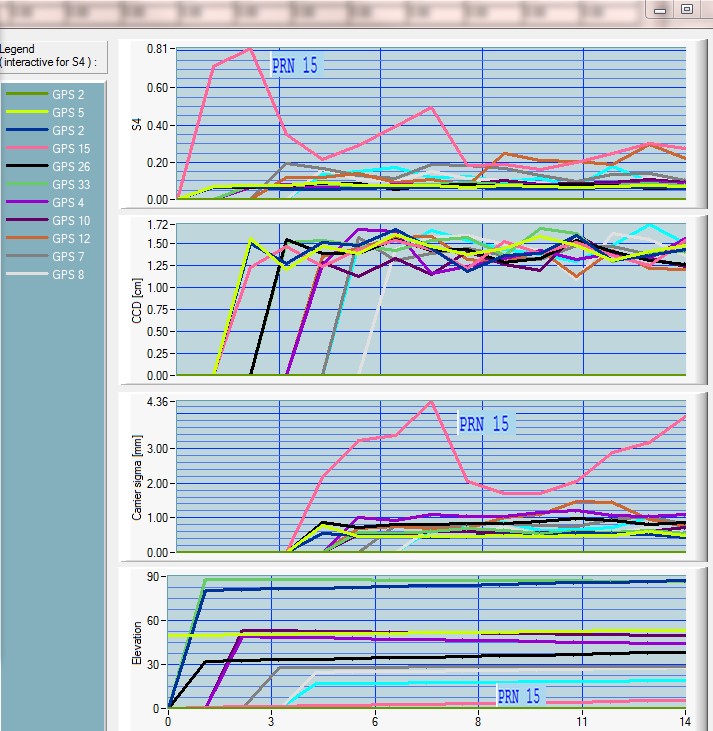
Primary scientific configuration
ARAMIS ISM is the primary scientific receiver configuration.
It combines the ARAMIS GNSS SDR receiver with scintillation observables, monitoring displays and configurable processing for amplitude, phase and propagation analysis.
ARAMIS ISM brochureRapid Application Development
RAD combines the ARAMIS SDR engine with PORTOS A8 multi-channel hardware.
RAD includes PORTOS A8, ARAMIS processing, NAV API and BASE API. It supports up to eight antennas, real-time processing, recorded-data processing, CRPA and integrated-navigation development.

Receiver architecture
All ARAMIS configurations use the same GNSS SDR receiver core and Microsoft Visual C++ software interfaces.
NAV API provides access to the navigation processor. BASE API provides access to the baseband processor. The same software can process ReGen-DIF, recorded PORTOS data or live RF through a PORTOS front end.
Academic editions, including limited no-cost licensing for selected non-commercial research and teaching use, may be available.
R&D applications
Use specialized observables, monitoring displays and configurable processing for amplitude, phase and propagation studies.
Work with acquisition, tracking, observables and positioning software through accessible processing interfaces.
Optional integration supports loose, tight or ultra-tight coupling and BGPS™ instant-positioning know-how.
BGPS™ know-howUse an Academic edition for individual research, laboratory classes and receiver-software study.
Software demonstration
A short demonstration of programmatic access to receiver navigation processing through the ARAMIS software interface.
Watch the Navigation API demonstration on YouTubeIndependent published evaluation
Dr. Mehul V. Desai, Dr. Darshna D. Jagiwala and Dr. Shweta N. Shah evaluated a customized integrated ARAMIS SDR receiver and PORTOS RF front end for NavIC L5 + GPS L1 research published in IETE Technical Review. The SAC/ISRO-funded work used the ARAMIS Navigation API and raw-data access, implemented grid-based ionospheric correction, and compared the results with an Accord receiver.
Read the paper (PDF) Publisher pageData & software access
ARAMIS can expose intermediate receiver data and processing interfaces that conventional commercial receivers keep closed.
Integration & laboratories
Optional IMU/INS integration projects support loose, tight or ultra-tight coupling and optional BGPS™ instant-positioning know-how. Current hardware support includes PORTOS A8 and Simceiver with receiver hardware options. Other PORTOS configurations depend on the selected front end.
See BGPS™ instant-positioning know-how See laboratories & training ARAMIS ISM brochureConfiguration enquiry
Tell us which constellations and frequencies are required, whether ISM monitoring functions are required, which processing levels must be accessible, and whether the receiver requires multi-antenna, CRPA, IMU/INS, simulator or laboratory integration.
Discuss an ARAMIS system